Photograph by Ed Soldo
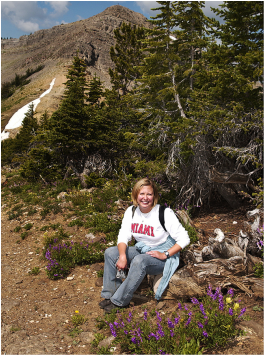
Meet Nature Nat!
Natalie Harr has been an early childhood educator for nine years at Crestwood Primary School. She currently teaches first grade and has also taught at the kindergarten level. She grew up on a large dairy farm in southeastern Ohio, where she developed her love for nature and the outdoors. She received her bachelor's degree in Early Childhood Education from Kent State University in 2004.
During the start of her career, Harr felt most confident teaching her students fundamental skills such as reading, writing, and mathematics. However, like many elementary teachers, her ability to teach science did not come naturally. With her frustration mounting, a colleague encouraged her to apply for a two-week summer graduate course called "Environmental Science for Elementary School Teachers (ESEST)." In 2006 she was selected to be a part of this rigorous course for Ohio teachers held at Yellowstone and Grand Teton National Parks through Miami University, Oxford, Ohio. The purpose of this grant-funded program is to train elementary school teachers to use environmental science across the curriculum to attain Ohio academic content standards and achievement test outcomes. The science course was so successful that fourteen Crestwood elementary teachers took the class throughout its duration, with several of these teachers, including Harr, returning to take it twice.
This experience ignited Harr's newfound passion for teaching science, especially in the early grades where quality science instruction seems lacking the most. In 2007 Harr was awarded a full tuition scholarship to pursue a Masters in the Art of Teaching in Biological Sciences from Miami University, Ohio. This was a rigorous content-based summer program offered jointly by the departments of Botany, Zoology, and Microbiology for teachers K-12. The same year she was also invited to join the ESEST teaching team in Wyoming and worked as a Master Teacher in 2008 and 2009. She obtained her MAT degree in December 2009.
Throughout Harr's graduate work, she became interested in the back-to-nature movement, sparked by Richard Louv's book called Last Child in the Woods. His book describes cutting edge studies that indicate how direct exposure to nature is vital for a child's healthy development. Harr conducted a research project that studied ways to increase young children's knowledge and awareness of plants. This research was so well received, that she was selected as a keynote speaker at the 2010 Earth Expeditions World Community Conference at the Cincinnati Zoo & Botanical Gardens.
In addition, Harr and several other Crestwood elementary teachers became part of Science in the Schoolyard. Directed by Roxanne Sorrick and Matt Sorrick of Hiram College, this grant-funded program aims to help teachers use their local natural environment in their schoolyard to teach science and other content areas across the curriculum. This place-based education idea was developed by David Sobel and has revolutionized how science is taught at our school.
Natalie Harr has been an early childhood educator for nine years at Crestwood Primary School. She currently teaches first grade and has also taught at the kindergarten level. She grew up on a large dairy farm in southeastern Ohio, where she developed her love for nature and the outdoors. She received her bachelor's degree in Early Childhood Education from Kent State University in 2004.
During the start of her career, Harr felt most confident teaching her students fundamental skills such as reading, writing, and mathematics. However, like many elementary teachers, her ability to teach science did not come naturally. With her frustration mounting, a colleague encouraged her to apply for a two-week summer graduate course called "Environmental Science for Elementary School Teachers (ESEST)." In 2006 she was selected to be a part of this rigorous course for Ohio teachers held at Yellowstone and Grand Teton National Parks through Miami University, Oxford, Ohio. The purpose of this grant-funded program is to train elementary school teachers to use environmental science across the curriculum to attain Ohio academic content standards and achievement test outcomes. The science course was so successful that fourteen Crestwood elementary teachers took the class throughout its duration, with several of these teachers, including Harr, returning to take it twice.
This experience ignited Harr's newfound passion for teaching science, especially in the early grades where quality science instruction seems lacking the most. In 2007 Harr was awarded a full tuition scholarship to pursue a Masters in the Art of Teaching in Biological Sciences from Miami University, Ohio. This was a rigorous content-based summer program offered jointly by the departments of Botany, Zoology, and Microbiology for teachers K-12. The same year she was also invited to join the ESEST teaching team in Wyoming and worked as a Master Teacher in 2008 and 2009. She obtained her MAT degree in December 2009.
Throughout Harr's graduate work, she became interested in the back-to-nature movement, sparked by Richard Louv's book called Last Child in the Woods. His book describes cutting edge studies that indicate how direct exposure to nature is vital for a child's healthy development. Harr conducted a research project that studied ways to increase young children's knowledge and awareness of plants. This research was so well received, that she was selected as a keynote speaker at the 2010 Earth Expeditions World Community Conference at the Cincinnati Zoo & Botanical Gardens.
In addition, Harr and several other Crestwood elementary teachers became part of Science in the Schoolyard. Directed by Roxanne Sorrick and Matt Sorrick of Hiram College, this grant-funded program aims to help teachers use their local natural environment in their schoolyard to teach science and other content areas across the curriculum. This place-based education idea was developed by David Sobel and has revolutionized how science is taught at our school.
Natalie Harr and Linda Froschauer, the editor of Science & Children ,
at the 2011 NSTA National Conference on Science Education.
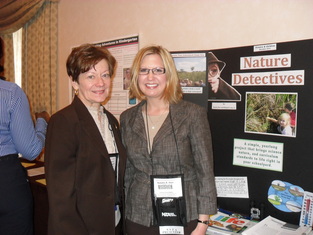
During her coursework, Harr also became acquainted with Dr. Lee, a professor and director of ESEST and the MAT program. For her final master's project, she and Dr. Lee coauthored Nature Detectives, a professional article featured in the National Science Teacher Association journal Science & Children in November 2010. Using ideas from place-based education, the article presents a yearlong project conducted by Harr's first grade "Nature Detectives" that brings science, nature, and other curriculum standards to life right in their schoolyard. With a focus on journaling, this project is a novel way for teachers nationwide to promote nonfiction writing in their classrooms. In March 2011, Harr presented Nature Detectives at the NSTA National Conference on Science Education in San Francisco, CA.
With Harr's strong background in elementary science and research, she was the first elementary teacher ever invited to join Dr. Lee's Antarctic Research team. During her Antarctic expedition, Harr used the schoolyard science approach and cutting edge technology to connect Crestwood students with real scientific learning taking place at the coldest, windiest, driest continent at the bottom of the world. Please check out her blog to experience this once in a lifetime adventure!
© 2012 The Crestwood-Antarctica Connection
